- Company
- Almon Inc., technical documentation for manufacturers
- Using Cortex since
- February 2026
- Challenge
- Expert review ran on emailed PDFs, so delivery dates slipped out of Almon’s hands
- Solution
- Zea Cortex, with long-form manual drafting and a built-in review function
- Result
- Review sessions set up in minutes, tracked comments, and delivery dates Almon can promise and keep
- Next
- Bringing clients onto Cortex to develop and publish their content
“When we saw the review tool come together, we saw the timeline for the review process just compress by an order of magnitude.”
Every technical manual Almon writes has to pass one final test before it’s delivered: review by the people who designed the machine. Almon’s technical authors can turn schematics, drawings and specifications into clear documentation, but only the manufacturer’s own engineers and subject matter experts can confirm every detail is accurate, fill the gaps and catch the errors. Their sign-off decides the quality of the final product.
For years, that step ran on email. A finished draft went out as a PDF and landed in a busy engineer’s inbox, where it often sat. Follow-up emails, calls and meetings piled up, and the delivery date slipped out of Almon’s hands.
“It really is a bottleneck point,” says Jim Asta, Technical Author at Almon. “This is a single point of failure that can interrupt the planned deliverable timeline.”
Working together, Almon and Zea have turned that bottleneck into a fast, trackable step inside Zea Cortex.
A critical step that’s hard to schedule
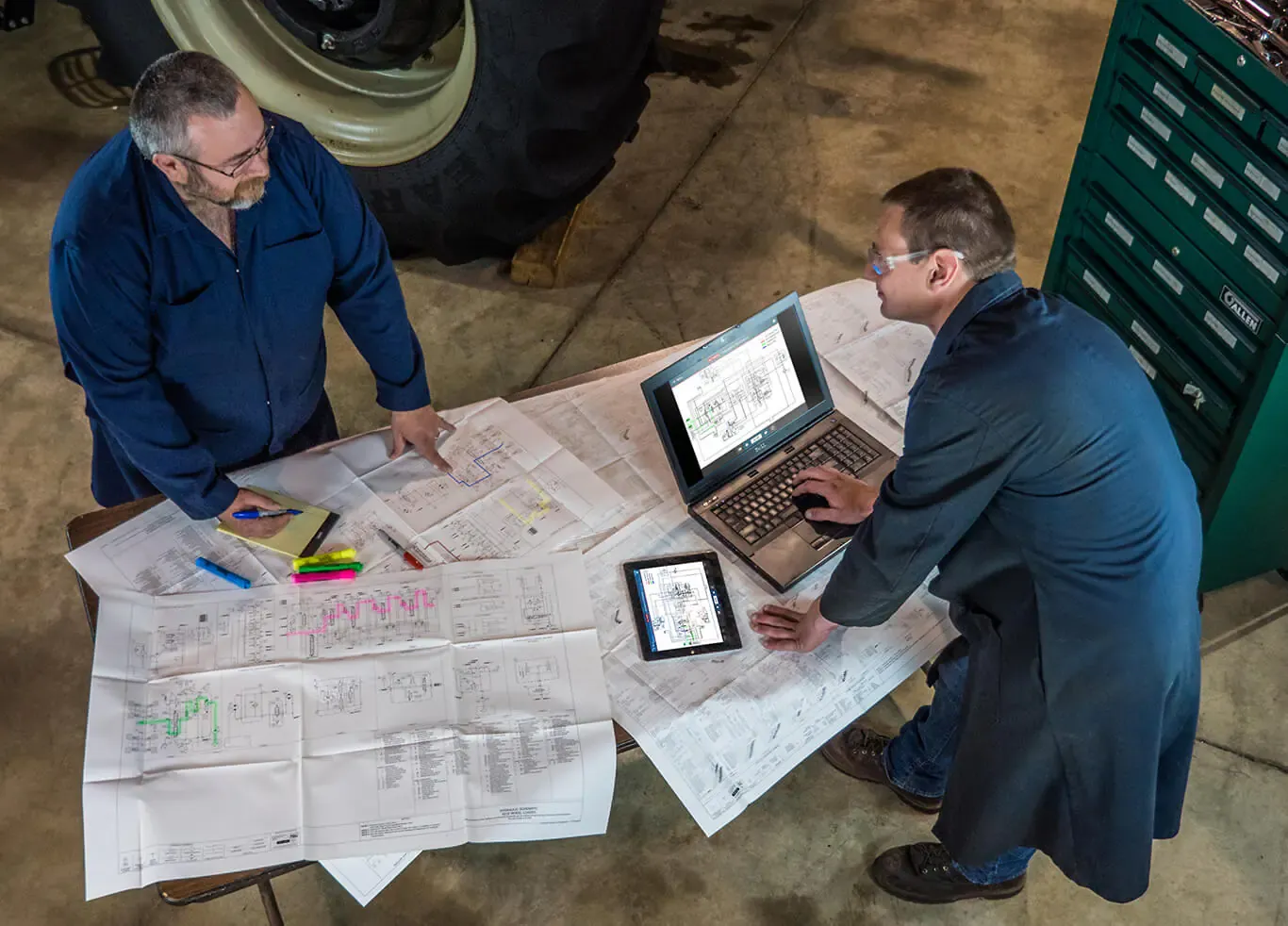
Almon has spent about 40 years creating technical documentation, training materials and other information products for manufacturers, including makers of off-road heavy equipment.
Jim says expert review is a vital step in the process: “We always need their input, and there will always be some need for filling gaps or making corrections so we can produce the best product for them.”
On every project, the hardest part of review is time. Reviewing a manual sits outside an engineer’s normal workflow, and because reviewers don’t know exactly when a draft will arrive, it’s hard for them to plan for it or set time aside from their core responsibilities.
That uncertainty leads to delays, and everyone pays for it: Almon’s carefully planned timelines stretch, the client’s experience suffers, and the reviewers themselves get pulled into extra follow-up meetings.
“If we have to do follow-ups, additional meetings, things like that for review, that’s taking even more of their time,” Jim explains.
From parts catalogs to Cortex
Almon’s relationship with Zea goes back a few years, to when Almon needed an interactive web parts catalog to complement its static documentation. Zea Parts filled that gap, including for turf harvester manufacturer Trebro.
In February 2026, Almon started working with Zea Cortex as a support offering for its own clients. At the time, Cortex was mainly a customer support platform with a limited article-writing function. As Jim used it, he started asking whether it could handle longer-form content, like full technical manuals. Zea said yes and, with Jim’s experience as a technical author and subject matter expert to guide it, the two teams built that capability quickly.
“Almon and Zea working together on that Cortex platform, it was catalytic,” Jim says. “We spun this up quickly. We were able to test, iterate, validate and just move forward.”
Building the review process together
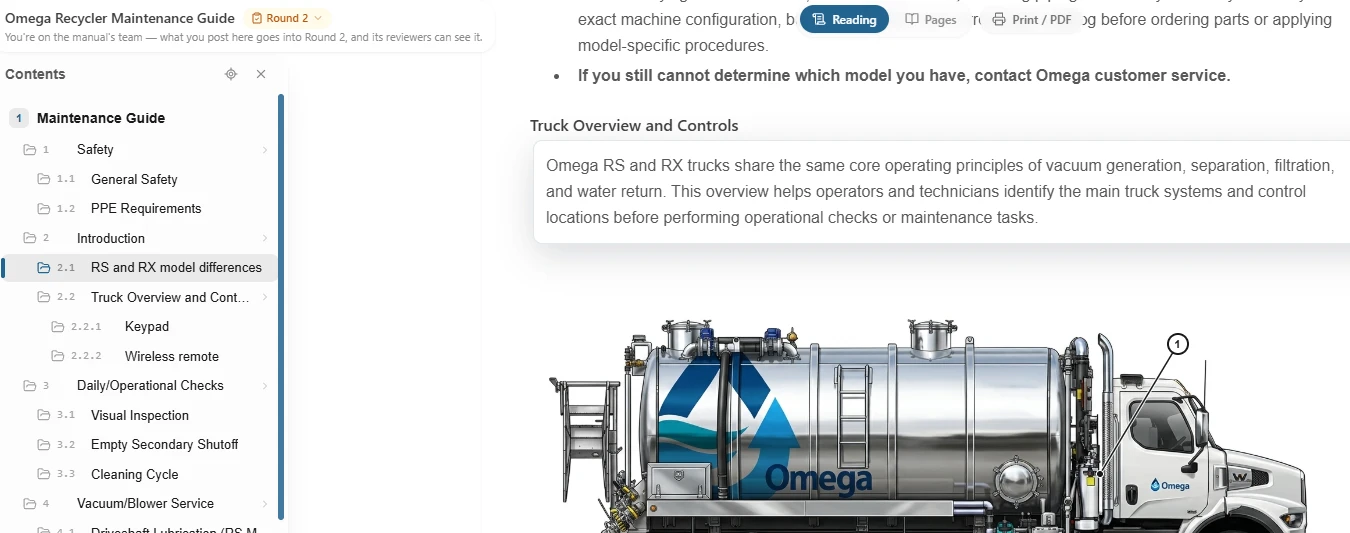
With Cortex producing strong drafts, the old review step stood out as the next sore spot. Drafts were still exported as PDFs and emailed to reviewers. So Almon asked whether review could happen inside Cortex instead. Again, Zea said yes, and quickly built and refined a review function within the platform.
Almon tested it the same way it now runs every review: authors and stakeholders reviewed the new process inside Cortex itself, using its own collaboration features to flag what could be better.
For Jim, the speed of that back and forth is what sets Zea apart. Zea uses AI tools in its own development, so a request for a new feature gets turned around fast.
“We’re getting a better software platform much more quickly,” he says. “So we’re winning on both sides there.”
From source material to first draft
Some parts of Almon’s process haven’t changed. Authors still gather and curate the source material (schematics, existing manuals, parts drawings and specification tables) and flag conflicting or outdated information early.
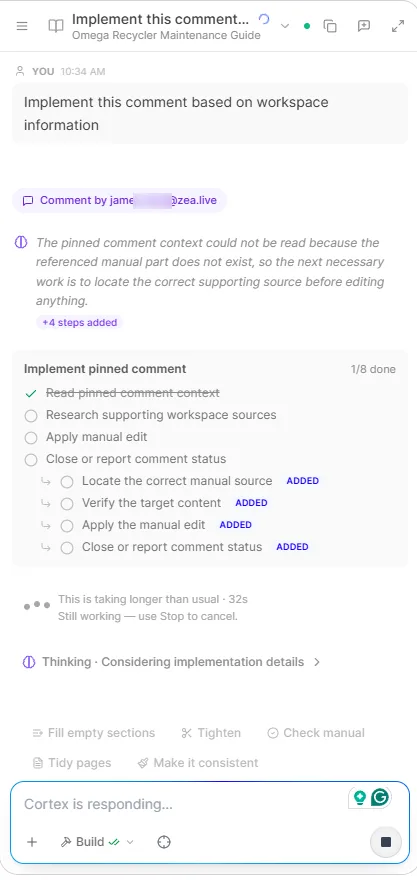
What has changed is Jim’s role. Instead of writing every section himself, he now works as a lead author, directing Cortex agents much as he would direct a team of writers. He gives Cortex the structure the client wants, and Cortex builds it out in its editor, including standards-compliant language and symbols. For a machine with hydraulic systems, for example, it adds the right warnings in the correct colors, so the content is compliant from the start.
Cortex also speeds up one of the slowest parts of technical writing: understanding the machine. To write a manual, an author first has to understand every part and how the parts work together. Before Cortex, Jim had to read through all the source material and piece together his understanding of every part and how they all worked together. It was time-consuming, and there was always risk of missing something.
“When Cortex writes a theory of operation, it’s not missing anything,” Jim says. “Its memory is perfect. Then I can look through that and very quickly gain a deep understanding of the machine and its systems.”
Human authors are still essential, especially on large projects. Almon’s writers bring electrical, mechanical and software expertise to guide Cortex and validate every section for accuracy, which they can do quickly and easily, because Cortex always cites its sources.
Review on a predictable schedule
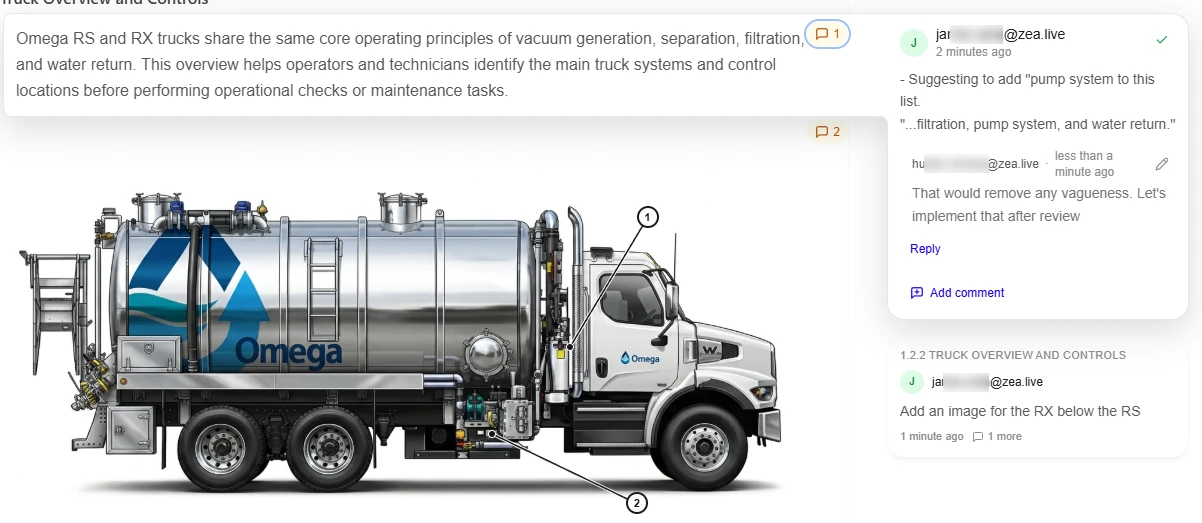
When a draft is ready, setting up a review session in Cortex takes just minutes. Reviewers get a link by email, click it and can start reviewing right away. Every comment, reply and action is tracked by user, date and resolution status, and authors and reviewers can work through comments together in real time instead of trading emails.
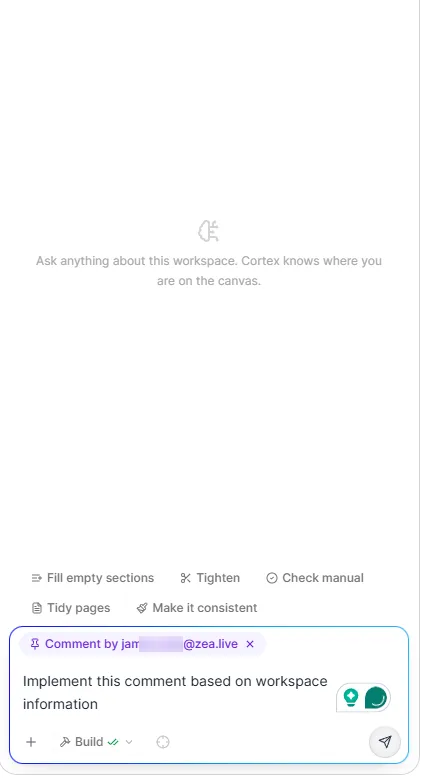
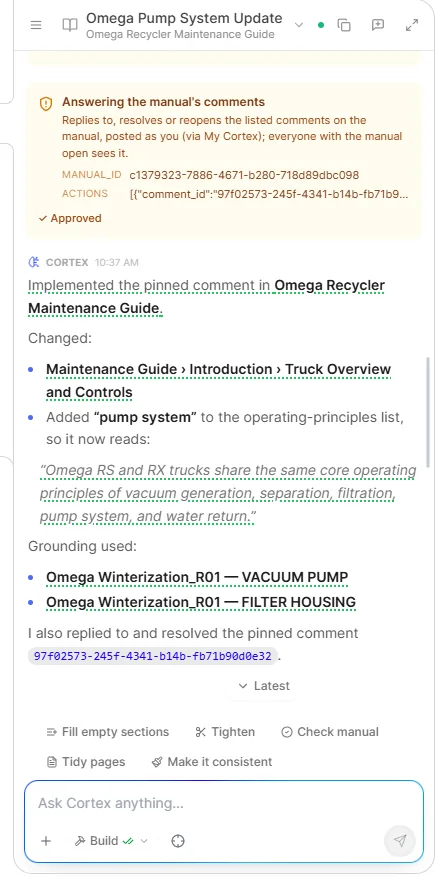
Another big time-saver: an author can ask Cortex to address a reviewer’s comment. Cortex works the fix into the content, or says it doesn’t have the information it needs, which flags a gap for the author to fill.
Reviewers still need to make time, and that won’t change. But because the development phase is now faster and more predictable, Almon can tell clients exactly when to expect a review, and keep that promise.
“We can offer certainty that when we said the third week of November, it is coming the third week of November,” Jim says.
That makes it much easier for clients to ensure their experts have the time required to dedicate to this task, helping keep the whole project on schedule.
Better outcomes on every front
Almon is just starting to bring clients onto Cortex to develop and publish their content, and Jim sees big opportunities ahead. Technical documentation is labor-intensive, and for many manufacturers it can feel optional, even though it’s key to keeping customers and winning repeat business. In the past, some prospects have received Almon proposals but simply couldn’t fit them into the budget.
With Cortex, Almon can go back to those manufacturers with a different offer: high-quality documentation, delivered faster and for much less. It also makes existing accounts more profitable and lets Almon respond faster when clients update their products.
“We’ve got a lot of different fronts where we can do things we couldn’t do,” says Jim. “Or we can do them better and faster and with a better business outcome for Almon and for our customers.”